



















Top 12 Easy Pecha Kucha Presentation Ideas That Actually Work
If executed properly, a good presentation is brief, to the point, and unexpectedly impactful. This page provides information about 20×20 format Pecha Kucha presentation ideas, as well as a practical advice on selecting a suitable topic, crafting an engaging tale, and delivering an easy-to-follow presentation. Discover the power of being authentic as you read our best recommendations for presenting your thoughts with conviction.
Avoid Being Forced Into a Topic by Allowing It to Select You
You should try to stick to familiar ground when choosing a topic for your Pecha Kucha presentation. Because self-assurance is key when slides go forward automatically, begin with material you know well enough to convey without notes. Avoid vague or overly generalised ideas; instead, keep them specific and easy to understand.
The issue could be too complex for this format if you find yourself considering presenting data in presentation style with charts or statistics. Stories, observations, and concepts that are readily visualised work best with Pecha Kucha. You have already conquered half of the challenge when your subject is simple to explain and picture, and when your presentation is natural, informal, and interesting.
Twenty-Slide Stories That Pop: Top Ideas for Pecha Kucha Presentations
The best Pecha Kucha presentations don’t seem forced or contrived. Simple, personable, and easy-to-follow ideas—even with fast-moving slides—tend to be the ideal for pecha kucha presentations. They are based on real-life experiences, observations, or lessons learnt the hard way. When the subject is coherent and the images bolster rather than explain the point, the presentation is natural, sincere, and unexpectedly memorable. Just to illustrate:
- The Event That Alternated My Perspective on Setbacks
- The Lessons I Learned About Time from My Regular Routine
- Little Practices That Subtly Affect Our Daily Lives
- A Spot I Will Always Remember and Why
- The Impact of Technology on My Thought Process What I Learned From a Little Error
- Arguments Against Boredom
- Mastering a Single Aspect
- What I Learned About Home from My Travels A Common Item With a Fascinating Backstory
- The Revolutionary Power of Declining
- Unusual Delights We Typically Disregard
How My Perspective on Failure Was Revolutionised by This One Event
In case you plan to tell a short, personal story about a moment when something went wrong and didn’t turn out as planned, then you’re probably on the right path to glory. Or, at least, to a solid presentation. Instead of hiding the failure, the presentation looks at what actually changed afterward. It’s about how one experience made failure feel less like an ending and more like a normal part of figuring things out.
What My Regular Schedule Taught Me About the Value of Time
After you slow down and enjoy the little moments, even a typical day may reveal a lot. Breaking down your daily activities into their component pieces might help you identify the times when the time flies by and the ones that seem too drawn out. Different habits create different effects; some make you feel rushed, while others allow you more time to relax.
Everyday Routines That Subtly Affect Our Prosperity
Major life events don’t affect you much. It’s the tedious, repetitive tasks that you do so seldom now. Whether it’s the way you begin your day or the automatic response you have if you’re anxious, it’s important to pay attention to these moments. Even while it doesn’t appear to be a “decision,” it becomes one over time.
Something I’ll Always Remember and Why
For some reason, certain locations simply never leave you. Why? Not because they’re famous or on every postcard; you can’t help but think of anything that happened there. No specific location is required; it might be a street, a café, or even a favourite corner. Explained in this presentation are the reasons why that location keeps popping up in your thoughts. What you were wearing, the people around you, and the atmosphere all had a role.
Some Ways in Which Modern Technology Has Modified My Thought Process
Nothing about technology made me think that way. It settled in gradually, influencing little routines. You check one alert, then another, and suddenly you’re in the middle of something else before you realise it. Who needs an answer these days? Instead of sitting with the question, you reach for your phone, and eventually, that becomes as natural as breathing.
Implications Derived from an Uncomplicated Error
Everybody makes “little” mistakes every now and again. They may not seem significant at the time, but they often end up being the biggest issue ever. It might have been anything from mailing the incorrect file to turning up on the wrong day, from believing someone else was responsible for a certain detail to just hurrying through something because “it’s probably fine.” Big mistakes seldom teach you the most. Each day, you make the same mistakes due to being overconfident, too sleepy, or preoccupied.
The intriguing element isn’t that it was a mistake. You learn a lot about your operation from it. Ignoring something is a common excuse for not verifying it twice. If they wish to appear competent, some people never seek for explanation. Yet another gang puts things off till the last minute, then dashes, and then acts as if nothing weird is happening. The pattern may be shown by a single slip-up, unlike a “big life lesson” that would never do.
In Defence of Boredom
Boredom is maligned, yet it’s actually a mental breather. Absolutely nothing to respond to—no alerts, no sound, nothing at all. The moment your thoughts begin to wander, you may find that previously evaded thoughts or ideas suddenly pop into your head. As an alternative to actively filling every empty time, this article suggests taking a second look at boredom.
Importance of Mastering a Single Task
You may find that you’re “busy” all day long, but that you never actually get anything done. At the end of the day, you’re exhausted and have accomplished nothing to show for all the time spent switching between tabs, messages, unfinished projects, and shortcuts. Here, your valuable speech can begin with a basic example: increasing one’s knowledge, completing a project, improving one’s talent (not necessarily one’s presenting abilities), or even just reading a new book continuously for more than five minutes.
Focusing on a single activity allows you to not only go more quickly, but also thoroughly. You tend to notice errors sooner. You have a knack for making wiser choices. This time, instead of always beginning again, you actually gain momentum. Furthermore, this is an opportunity to criticise the “stuffing everything in” mentality. Work and presentations both make use of this technique. It seems like every time I give a presentation, someone is interested in knowing how many slides for a 20 minute talk.
What I Learned About My Own Home from Travel
Travelling has this peculiar effect of making home seem more organised. The things you normally don’t give much thought to pop into your brain while you’re away from home for a long. The routines you follow on a daily basis, the comforts you rely on, the noises and habits you adopted without realising they were “yours.” As you shift your focus from the walls to the things around you, your perception of home changes as you travel. Facts like this are usually not the main emphasis of standard PowerPoint presentations. for that reason it will be well appreciated by both the speaker and the listeners.
A Common Item With a Prodigious Backstory
Ask yourself why an everyday item, such as a cracked mug or a battered wallet, is still with us. Regardless of its aesthetic value, you should always remember the person who gave it to you, its history, the memories it evokes, or the reasons it has a significant place in your life. Without the backstory, the item wouldn’t be noteworthy. The most important thing is to leave an impact rather than just wow with your graphics.
When I Refused to Accept Anything, Everything Changed
The capacity to decline requests is one of the most essential and ageless skills. A lot of the stress will melt away once you stop viewing it as your duty to fill everyone in on every detail. Yes, you should rehearse saying “no” as much as you need to. This kind of small chat is usually not the main point of most presentations, even if it might have an influence.
It may be a bit strange at first, but once you get the hang of it, you’ll notice all the good changes: you’re not as stressed, you’re not obligated to do things you don’t like, and you have more time for the things that are important to you and your workplace. Because it is compatible with this premise that good slides are constructed, the use of an inexpensive AI presentation builder also often brings up this thought. Adding more features won’t improve them.
Subtle Joys That Frequently Remain Unrecognised
To make a good presentation, pick a few important ideas and gently work them into your slides. Don’t add unnecessary material. Using a single image for each detail on every slide. Extensive visual design is superfluous; just tell the story this way. Describe what you witnessed and clarify the message’s intended meaning. One way it may be funny is if you realise you’ve been driving past the same sign all year without ever reading it.
I think that’s more than enough to make compelling stories. Even something as seemingly little as seeing a bird in the same spot every morning while you wait for the bus or tram may tell you a lot. Because of your positive attitude and creative ideas, the pet owners would definitely like the whole presentation.
Closing Thoughts: Ending Strong With Pecha Kucha
Good Pecha Kucha presentations start with one idea you can explain to your business partners in a vocal tone. If there is a refreshing alternative in the corporate world, and it even makes sense to you, then you might just nailed it. Let those good old pictures and images back you up as it almost always maximizes engagement. Keep your wording like real speech, and don’t try to cram in extra points. When you hit the end of presentation, trust the timing, stick the landing with one clear final thought, and stop there.
Need a Hand With Your Pecha Kucha Presentation?
If you’re reading this and thinking, “I get the idea, but I’d still love a hand,” you’re not alone. Putting together a Pecha Kucha presentation can be tricky the first time. Visual coherence is definitely the key – or at least, one of the keys. That’s exactly where Decksy’s AI generator can help. Skip the design struggle and let our AI instantly build a Pecha Kucha presentation that actually feels good to present.
FAQ
What is Pecha Kucha?
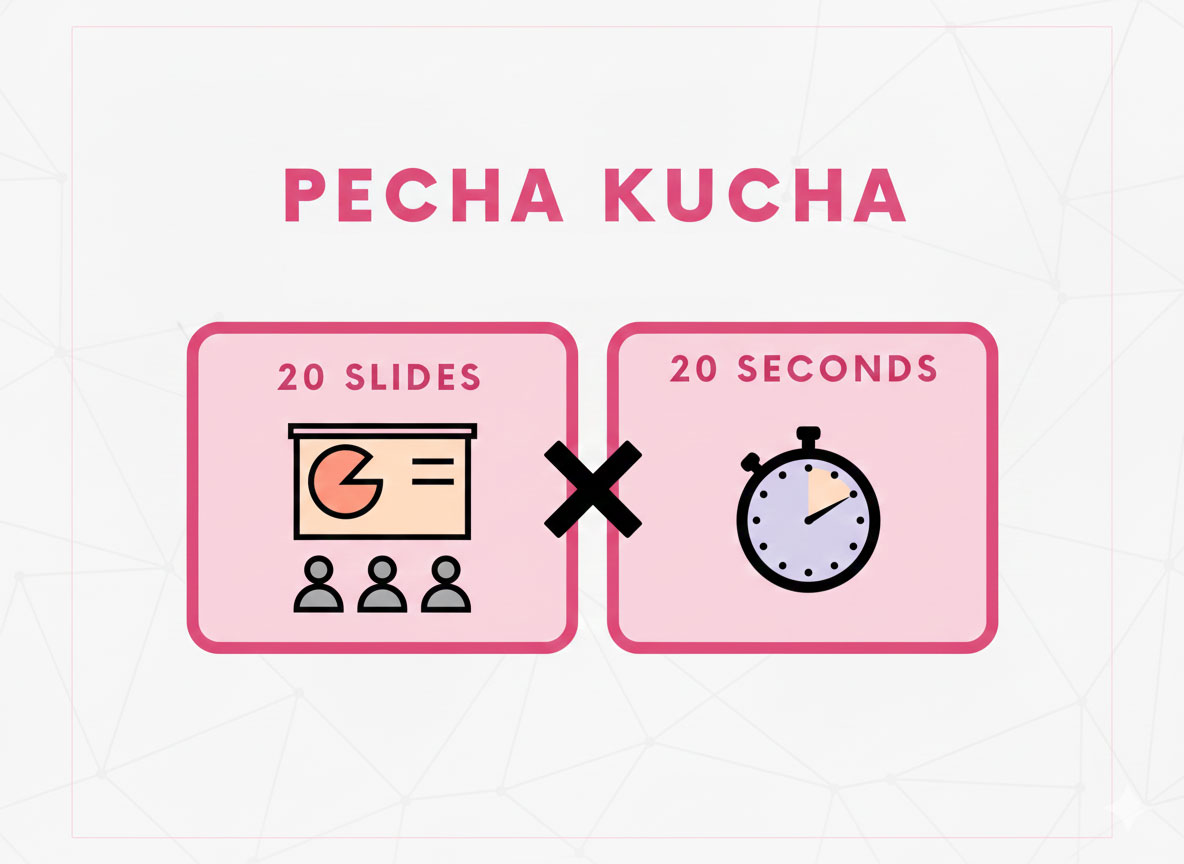
Pecha Kucha is a unique presentation format that uses 20 slides shown for only twenty seconds each, hence promoting concise communication towards the audience.
Why choose PechaKucha presentations?
Because it’s the simple but impactful presentations that keep the audience engaged and interested at all times.
What is the best possible Pecha Kucha topic for a presentation?
Personal stories and simple ideas work the best. If you can pick a topic that is easy to visualize and won’t require heavy explanation, then you’re good to go.
Do I need special design skills to create a visual impact on Pecha Kucha slides?
Not at all. Make sure you choose high quality images, consistency, and restraint matter more than flashy design. If your visual storytelling supports your story instead of explaining it, you’re on the right track and the audience focus will be kept easily.

Sarah Michelle Carter is the Chief Human Resources Officer at Decksy, and the person most likely to remind you that a company's culture is built in the small decisions, not the mission statement on the wall. She's pragmatic about AI — not an evangelist, not a skeptic, just someone who's watched it quietly clear out the repetitive parts of the job so there's more room for judgment and attention. Known for asking better questions than she answers, she's a go-to voice on culture, leadership, and where AI genuinely helps teams versus where it gets in the way.