




















How to Make Business Presentations Professionally
- Different presentation types demand tailored approaches.
- Use an AI presentation generator to effectively communicate your message, automate your design, and persuade your audience instantly.
- By avoiding overloading slides with text and ignoring your audience's needs, you can make sure your presentation will convert.
- Remember, practicing delivery significantly improves presentation effectiveness.
You know your content inside and out, but translating that knowledge into slides is a whole different challenge. One poorly designed presentation can undermine months of hard work in front of your boss.
But how to make a business presentation? In our complete guide, you’ll learn about different presentation types and how to master presentation skills, but we’ll also share some valuable business presentation tips.
What is the Purpose of a Business Presentation?
Convincing business presentations are strategic communication tools that are supposed to be informative and motivate your audience to act. You’ll soon realise that leveraging a smart AI presentation generator delivers better ROI by eliminating expensive agency fees and hours of manual design work.
For example, conference and keynote presentations position you or your organization as thought leaders as you share valuable insights. Sales presentations aim to convert leads into customers by demonstrating value and handling objections. Finally, investor pitch decks seek to secure funding by promoting market opportunities and showcasing growth potential.
Types of Business Presentations
Let’s see 3 distinct types of business presentations up close.
Informative Presentations
Informative presentations’ primary goal is sharing knowledge with your audience without necessarily asking for a specific action. When they’re effective, they clearly explain concepts, processes, or data. They do so by organizing complex information logically and using clear data visualizations. They succeed when audiences leave with an accurate understanding of the topic and can apply that information in their work.
Persuasive Presentations
Persuasive business presentations aim to influence audience opinions, decisions, or behaviors by presenting compelling arguments and evidence. They present logical arguments while appealing to listeners’ emotional sides. For instance, sales presentations show potential clients how your product or service can solve certain problems.
These presentations include customer pain points, solution features, success stories, competitive advantages, and calls to action, while investor presentations must be brief, topical, and concentrate on your business opportunity and competitive advantage. Remember to make financial forecasts and demonstrate team capabilities. Decksy’s AI platform can instantly offer the professional design quality that you need in stakeholder situations where you are competing to get attention and capital.
Demonstrative Presentations
Demonstrative presentations show audiences how something works through detailed walkthroughs or live demonstrations. Product demos and technical workshops are great examples of this kind of presentation. Such formats emphasize practical application and use screen recordings or live demonstrations to support verbal communication.
Tips for Giving an Effective Business Presentation
Here are our tips to make your business presentations stand out.
Start with Clear Goals
You need to establish what your audience wants to know, feel, and do at the end of your presentation. To do this, you must have clear objectives in mind.
Know Your Audience
Research your audience’s level of knowledge, priorities, decision-making criteria, and concerns before you write your presentation.
Follow the 10-20-30 Rule
Legendary VC Guy Kawasaki suggests that presentations should have 10 slides, take no more than 20 minutes, and have a minimum font size of 30 points. This structure compels you to adhere to concise and crucial information while making it readable and memorable.
Create a Narrative Arc
Organize your presentation as a story with a beginning, middle, and end. This form of narration makes tales especially easy to read and recall. Use AI to instantly structure and generate your PowerPoint presentation for maximum impact.
Use the Pyramid Principle
Busy executives prefer to know your key takeaways straight away. By adopting this approach, you ensure that your core message is received.
Maintain Visual Harmony
Create brand-aligned templates, using consistently polished fonts, colors, layouts, and design throughout your deck.
Consciously Use White Space
Resist the temptation to fill every inch of slide space. White space improves readability and directs attention.
Replace Bullet Points with Visuals
Always use infographics instead of a list of bullets with a lot of text.
Tell Stories Using Data
Explain what numbers stand for and why they matter. Highlight patterns and trends to guide interpretation and comparison.
Design for Scannability
Use hierarchical typography with large headlines that communicate main points.
Practice Purposeful Repetition
Reinforce critical messages by restating them to improve retention levels. In other words, discuss the same topic in other ways or with supporting evidence.
Prepare for Technical Difficulties
Always have backup plans for technology failures. Save presentations in different formats and locations (USB drive, cloud storage, email).
End with Next Steps
Conclude every business presentation by coming up with specific actions, responsibilities, and timelines.
What Should Definitely Be Included in a Business Presentation?
Although the exact content depends on the type of presentation, some aspects are included in almost all business presentations. Here are our guidelines.
An Engaging Title Pitch
The following should be included in your opening slide.
Include the following: the title of your presentation, your name, your position, the date, and maybe even the name of your audience.
A Plan of Action
Tell the audience what you’re going to cover and in what order at the start of your presentation. Doing so aids the audience in following your reasoning right away.
Issue Identification
Get your presentation’s central issue, problem, or question out in the open. Make sure to center your presentation around topics that resonate with your audience.
Honest Information and Proof
Use reputable sources, studies, and examples to back up your claims. Make sure to measure the effects and advantages as much as you can.
Design Elements and Visual Hierarchy
Professional design should bolster the efficacy of communication. Maximise the use of typeface, colour, size, and placement while designing layouts.
Take Action Now
Clarify, concretise, and make a reality your intended course of action. Effective calls to action transform focus into results.
How to Begin a Professional Presentation?
To grab your audience’s attention right away, start with an attention-grabbing hook. Possible choices are:
- Surprising data, thought-provoking enquiries, pertinent anecdotes, bold assertions, and recent happenings.
- Following your hook, quickly outline your qualifications to deliver this material by outlining your pertinent work experience, academic background, and awards. Your audience will have more faith in your knowledge and abilities thanks to this positioning.
- Make it crystal clear what you want your audience to take away from your presentation. If you listen to this presentation all the way to the end, you will…” Consequently, use your agenda or road map to introduce your primary arguments in a natural way.
- Communicate with the people who are watching. Maintain eye contact, smile, and connect with them by recognising commonalities or struggles.
Errors to Prevent in Corporate Presentations
Making these common mistakes in business presentations was something we set out to do.
Placing Text on Slides
Slides with a lot of text force viewers to pick one of reading or listening. Keep each slide to a minimum of text and give all necessary background information verbally.
Skipping Over Audience Needs and Knowledge
Always keep in mind who you’re speaking to, what they believe, and how knowledgeable they are. Do your research on who you’re writing for before you start.
Ineffective Use of Time
Excessive speaking time betrays an absence of research and disregard for the listeners.
Ignoring the Influence of Narratives
Without any personal connection, presentations that are heavy on statistics come across as lifeless and uninteresting. To illustrate your point, use anecdotes or customer examples that are relevant to your life. Initiating emotional engagement and clarifying concepts can be achieved in this manner.
Missing the Mark on Question and Rebuttal Anticipation
Think about the criticism you might get and incorporate it into your presentation or be ready with detailed responses for the question and answer session. Doing so will demonstrate that you have thought critically about your subject.
[BONUSES] 5 Exemplary Business Presentations to Get You Started
Look at these examples of effective business presentations to get a feel for what works in the real world.
The Original Airbnb Pitch Deck

The 2008 investor pitch deck for Airbnb laid out the reasons why their service was necessary and the steps they would take to establish a long-term business. The deck was successful despite its simplistic design in comparison to modern standards, thanks to its compelling value proposition and well-organised information flow.
Zuora’s Subscription Economy Presentation

In 2016, Zuora did a great job of informing her audience about the “Subscription Economy” change in the market that is impacting every industry. By establishing their solution as inevitable, their thought leadership presentation elevated the problem they solved to a new level of urgency.
LinkedIn’s Series B Pitch Deck
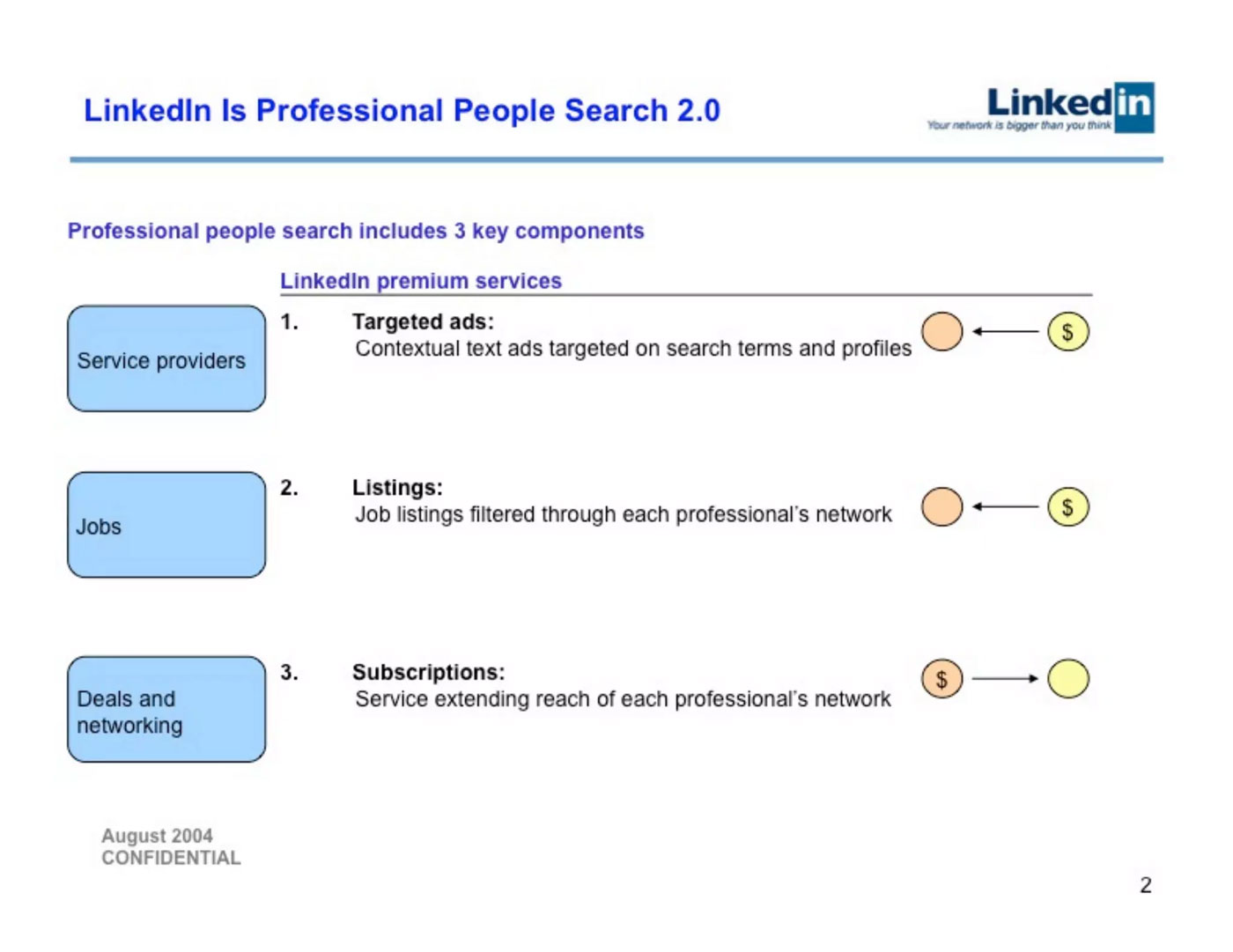
Qualitative insights were presented alongside quantitative data regarding user growth and engagement in LinkedIn’s 2004 Series B presentation to investors. Outlining their goals for professional networking and showcasing growth metrics, the deck made use of consistent visual solutions and data visualisation.
WeWork’s Investor Presentations

In 2014, WeWork used visual storytelling in their investor presentations to build excitement and anticipation. To market an idea beyond just renting an office, they used eye-catching visuals, dramatic typography, and inspiring words.
Tesla’s Master Plan Presentations

Product demos serve to construct aspirational narratives regarding electric vehicle mobility in Elon Musk’s multiple Tesla Master Plans (2006–2025 to date). In order to pique the interest of those who aren’t technical in engineering, these presentations rely heavily on narrative and high-quality visuals.
Last Thoughts
A logical structure is essential when creating investor decks, sales pitches, or presentations for conferences. However, it is insufficient. Make sure your message is crystal clear and speak with conviction. Overall, making an effective presentation used to take a lot of time and specialised design abilities, but now it only takes seconds with Decksy’s AI generator.
FAQ
For a business presentation, what is the standard format?
Keynote, PowerPoint, Google Slides, and Prezi are some of the most common presentation formats used in business. While most corporations use PowerPoint because of its extensive compatibility, many startups favour Google Slides for team collaboration.
Advice on making a professional presentation.
Get your key points down on paper before you start making slides. The next step is to create slides that will serve as triggers for your live presentation. If you want to be a better public speaker, you should practise your speeches until you can control your time better and think of possible criticisms and comments before giving them. Finally, put all technology through its paces in advance and have a backup plan ready.
Tell me about the five P’s of presentation.
To deliver an effective presentation, follow the 5 P’s framework: plan, prepare, practise, perform, and be passionate.
For a business presentation, what is the ideal duration?
With questions and answers included, most investor pitches last around fifteen to twenty minutes. Slideshows typically last between thirty and forty-five minutes. Speakers at conferences often address the audience for twenty to thirty minutes.
How can one generate compelling business presentations?
Talking about issues that matter to your audience before offering solutions is a good first step if you want your business presentation to be both effective and convincing. Case studies and testimonials are compelling pieces of evidence that can be used to support claims. See what Decksy can come up with for you by checking out our AI presentation showcase if you need more ideas.

On decksyai.com, where clarity still matters, but results matter just as much, Alyssa Johnson, Chief Revenue Officer, looks at messaging through a growth lens. She pays attention to how structure drives action, how a well-timed pause improves conversion, and how AI is reshaping all of it — without ever replacing the human instinct behind the message.