


















The hidden work behind lesson presentations. What do teachers really spend their time on?
Decksy surveyed 1,036 U.S. teachers and found that 71% prepare lesson presentations outside scheduled working hours at least sometimes.

When does a teacher’s workday actually end? Is it when the final bell rings, or hours later, after adjusting slides, finding visuals, and building worksheets at the kitchen table?
Teacher lesson preparation involves a complex workflow. It ranges from structuring content and converting existing lecture notes into slide decks to creating supporting handouts, quizzes, and assessments.
In a new study, Decksy surveyed 1,036 current full-time and part-time teachers in the United States to examine the hidden workload behind presentation prep and the role of AI models in streamlining it. The survey revealed that 71% of educators prepare lesson presentations outside scheduled working hours at least sometimes. It indicates that presentation prep is an increasingly common daily burden that spills into personal time.
Below, we analyze the full survey results. We break down where teachers spend their prep hours, how they develop teaching materials, how AI tools are saving time, and what they would do with two extra hours added back to their schedules.
Key Insights on Lesson Planning
- 70% create or significantly update at least three lesson presentations in a typical week.
- 71% prepare presentations for their lessons at least sometimes outside of regular working hours.
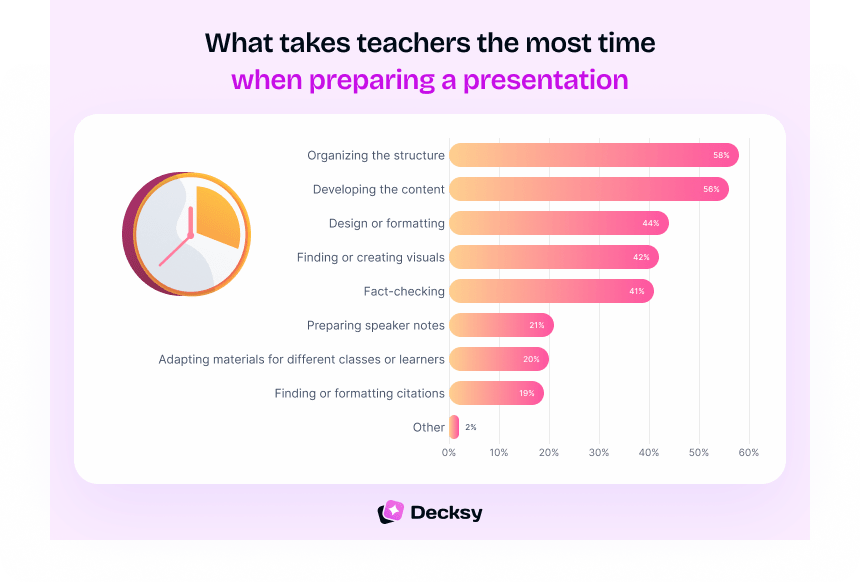
- 58% said that planning the structure of a lesson was one of the most time-consuming tasks.
- 69% spend another 30 minutes or more on supporting materials after the presentation is ready.
- 82% of teachers who use AI models believe it saves them at least an hour a week.
- 41% would not trust Artificial Intelligence with factual accuracy without their own final review.
- 43% said that if AI tools gave back two hours a week, they would spend them on better individual attention to students.
Why planning lessons and presentation prep is not a once-a-week task
70% of teachers produce or update three lesson presentations per week on average. 14% work on 11 or more.
Across an entire school year, that amounts to hundreds of lessons created. These are not quick fixes that can be put off for several weeks; 50% of teachers take more than one hour to prepare their teaching material into a single set of Google Slides.
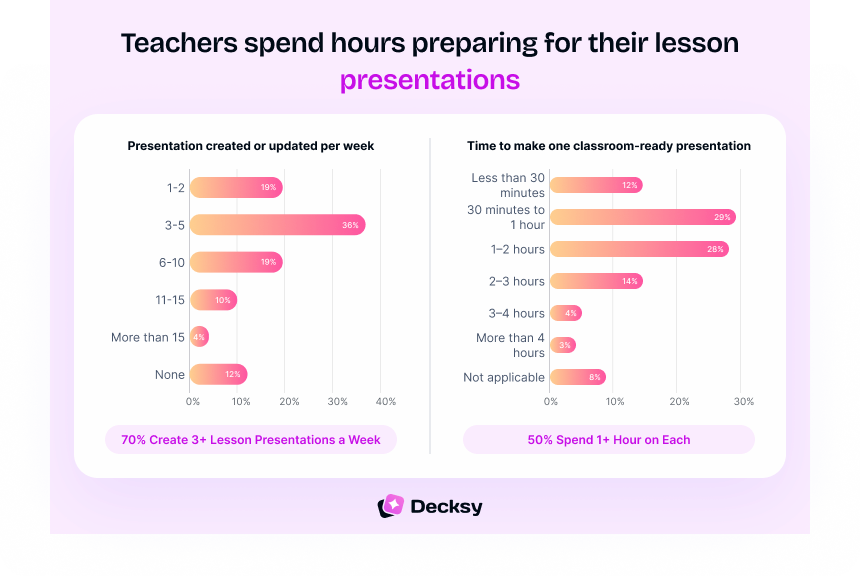
That makes presentation work less of an occasional design task and more of a repeating production cycle.
Tips on presentation skills or finding the best presentation templates can help you achieve the desired outcome. But teachers still need to decide exactly what to include in a lesson planning, how to structure it, and how to make it effective for the class they’re teaching.
For 71% of teachers, presentation prep crosses into personal time
Only 22% of respondents said they work on lesson presentations exclusively during their scheduled working hours.
The rest either work outside those hours at least sometimes or do not have clearly defined working hours. Most importantly, 71% said presentation work crosses beyond their scheduled hours at least some of the time.
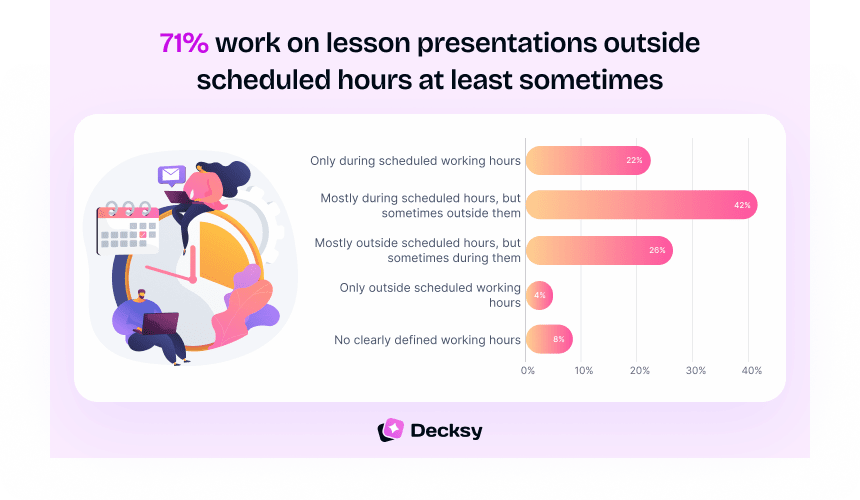
That does not mean 71% do most of their preparation at home. For 42%, the work happens mainly during scheduled hours but sometimes spills over. This issue extends beyond the United States, as global teacher workload management remains a critical challenge.
Teachers in Germany work 18 unpaid hours per week, UK instructors add 14 unpaid hours per week, and educators in Spain work 8 unpaid hours per week.
The story is the spillover itself — presentation prep is one of those jobs that can keep expanding until the lesson is actually ready.
58% spend the most time structuring lessons, not designing
If presentation work were mostly a formatting problem, faster design tools would solve most of it.
Our survey suggests otherwise. Traditional professional development often focuses on design tips or template selection. However, structuring the lesson and breaking down key points became the most frequently chosen lengthy activity at 58%, followed by content development at 56%.
Organizing resources in advance of lesson preparation anticipates students’ needs and makes logical structure far more critical than visual polish.
Teachers already have the material; they need help turning it into a lesson
The typical workflow does not start from an empty prompt for the AI.
- 59% start lesson presentations from personal notes.
- 57% start from PDFs to PPTs.
- 54% start from documents in Word format.
- 34% use existing presentations.
26% of the teachers have started their lesson presentations with an AI prompt. Overall, 70% of them use AI tools regularly or occasionally for lesson planning.
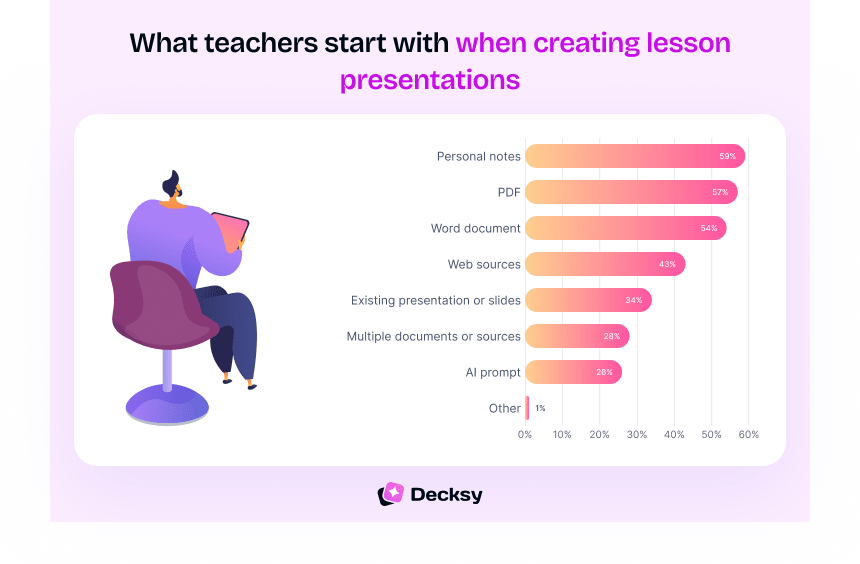
However, teachers do not begin there. Teachers already have lecture notes from last semester, an old presentation, a PDF file, academic papers, or several sources that need to be combined with text into a single PPT deck.
In fact, many now rely on AI tools that can summarize long academic papers for lesson prep, turning complex research into bite-sized classroom content. When forced to start from scratch with simple prompts, generated presentations fail to reflect teacher-specific content — especially those created from blank prompts. The last ones feel generic rather than classroom-ready.
| “For an AI presentation maker, the more useful question may be less ‘What should we generate?’ and more ‘How do we turn the materials educators already have into something classroom-ready?’ The survey suggests they need AI models to work with their existing notes, PDFs, and documents, not just generate interactive slides from a blank prompt,” says Sarah Michelle Carter, Chief Human Resources Officer at Decksy. |
The work doesn’t stop when the interactive slides are done
Finishing the deck rarely means finishing the lesson, because:
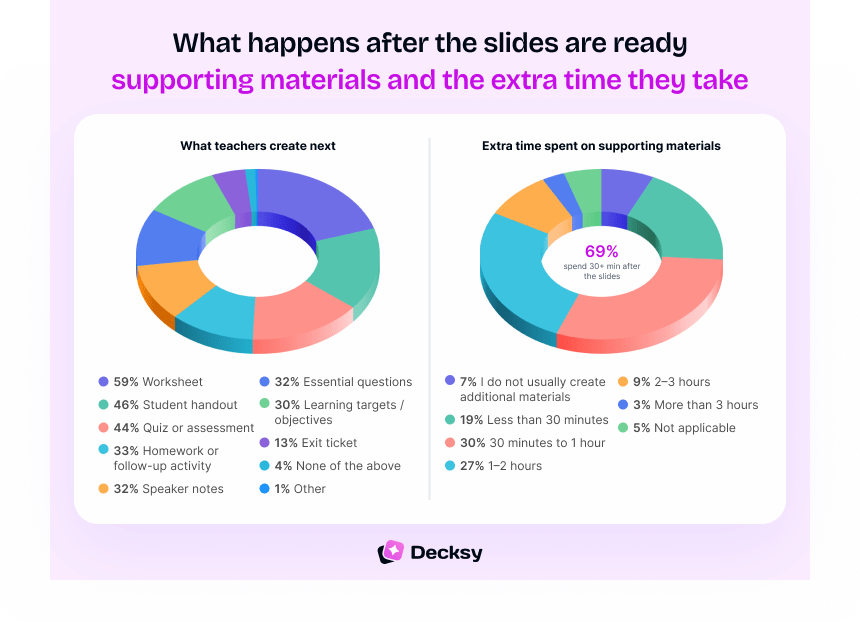
- 59% of teachers create worksheets after preparing a presentation;
- 46% create handouts;
- 44% create quizzes or assessments, writing everything from quick quiz questions to comprehension questions for exams;
- 33% prepare homework or follow-up activities;
- 32% create speaker notes;
- Only 4% selected none of the additional materials listed.
And those materials add another layer of preparation.
69% spend at least another 30 minutes on them after the presentation ends. Teachers often upload them directly to platforms like Google Classroom and tailor exercises to meet the needs of diverse learners.
Specialized platforms are already stepping in to ease this burden. For example, MagicSchool AI helps create worksheets and draft emails, allowing teachers to handle post-presentation tasks much faster.
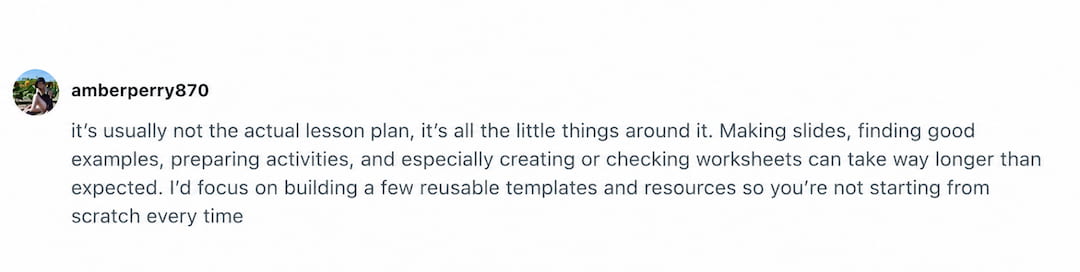
A teacher on Reddit shared a similar experience: preparing for a class often takes more time than planning the lesson itself.
This may be the clearest definition of the hidden work behind lesson presentations. The deck is visible. The ecosystem around it is not.
AI tools are saving time, but teachers are keeping the final say
AI is already part of the workflow for most respondents. 70% said they use AI models for lesson planning regularly or occasionally. As professional development programs increasingly incorporate AI tools, teachers learn to use these tools to streamline administrative tasks while maintaining control over factual accuracy.
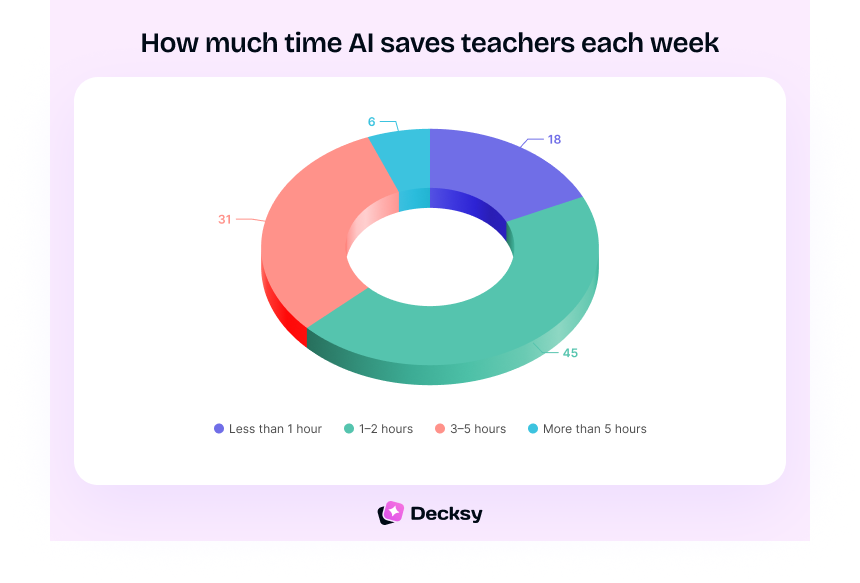
Among AI users, 82% of educators said it saves them at least one hour per week. 37% of teachers who use AI save three hours or more per week.
54% of teachers use AI for fact-checking lesson materials
54% of teachers who use AI models apply them for fact-checking, making it the most common AI use case in the survey.
A similar pattern appears among student data. According to EduBrain, 88% of students utilize generative AI to check their progress or detect mistakes before handing in their assignments.
79% of teachers who trust AI without review work full time
Among teachers who would trust AI without additional review, 79% are full-time.
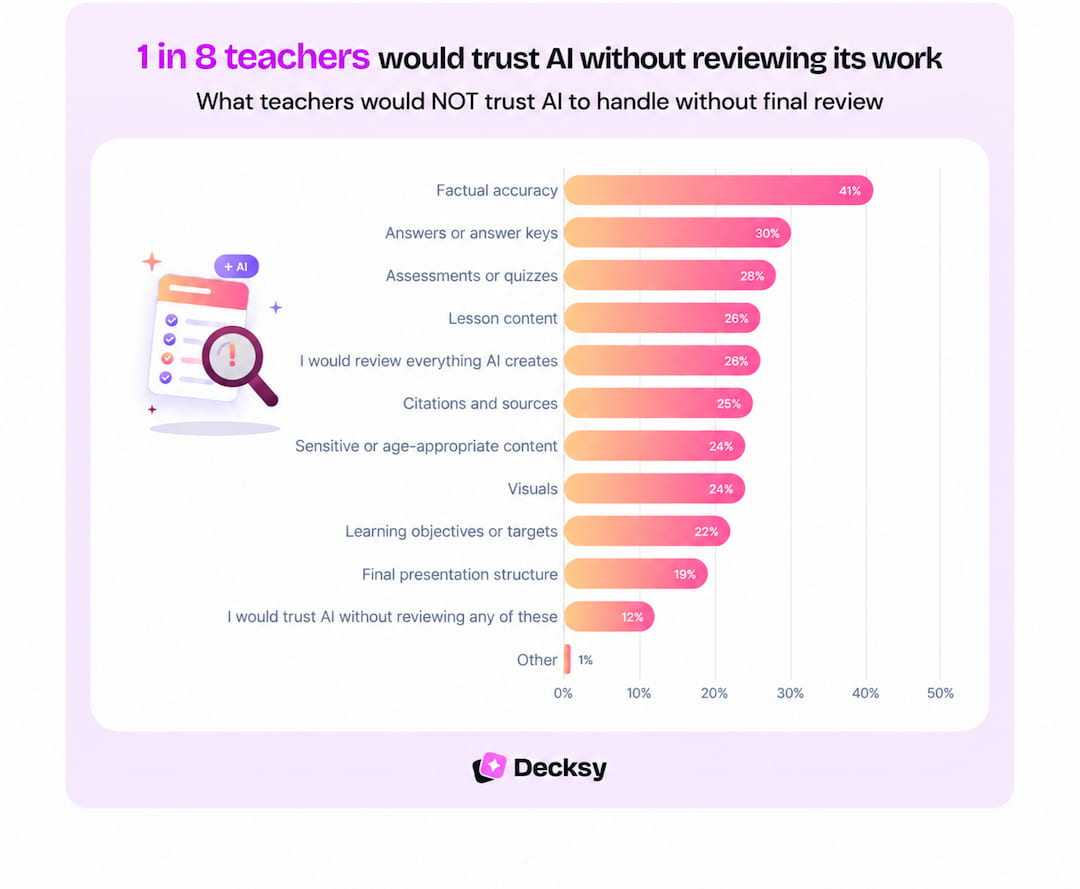
Only 12% of teachers responded that they would trust AI without reviewing it. On the other hand, 41% stated that they would not trust AI to manage factual accuracy without their review.
It seems AI is becoming a tool for checking and improving the work of both students and teachers.
Give teachers two hours back, and many would rather focus on student engagement
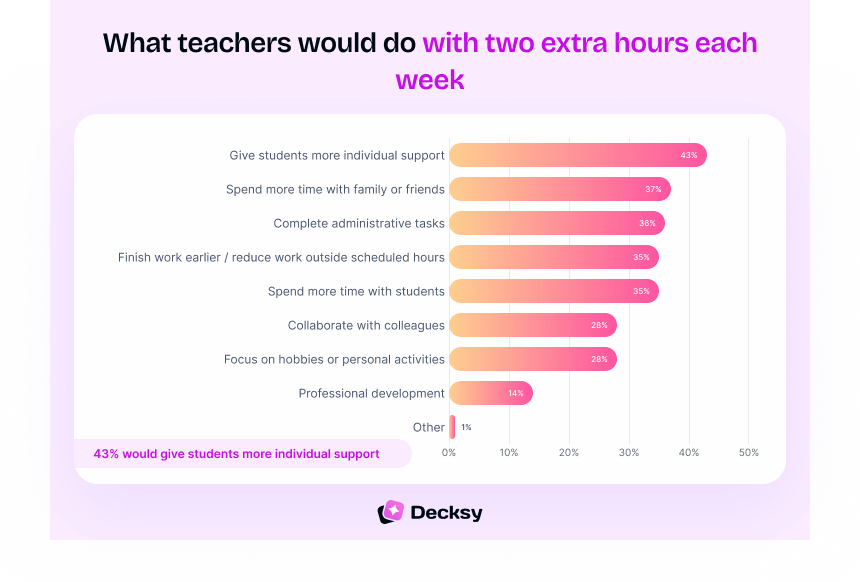
We asked respondents what they would do if AI models saved them two hours of lesson planning every week.
Interestingly, the most common response was not to reduce work. 43% of the teachers stated that they would devote an additional two hours per week to guiding students, thereby directly driving higher student engagement. How students respond to this personal human touch and extra one-on-one time often makes a significant difference in learning outcomes, which puts the value of automation into perspective.
The point of faster lesson preparation is not just speed. Time removed from repetitive work can return somewhere else: to students, to unfinished responsibilities, or simply to the teacher’s own evening.
The bottom line: the slides are only the visible work
The easiest part of lesson planning to see is the presentation on the screen.
The survey reflects all of this behind it: organization, information, graphics, fact-checking, adaptation, exercises, tests, and additional time that preparation takes beyond class hours.
AI tools are already reducing some of that load. Yet the role of teachers does not seem to be to let technology take over the class. Instead, they use technology to speed up certain aspects of the process while maintaining control over accuracy and the class experience.
| “The Decksy survey shows that AI is already giving teachers meaningful time back each week. We’d like to see more educators get to the point where it saves them several hours.
Those minutes can really matter. They can be used in classroom materials, for individual attention, or even just to help teachers end the day with less on their plates. The real opportunity is not to automate teaching. It is to take some of the invisible preparation work off teachers’ plates, so they can spend more time on great teaching — focusing on the parts of the job that really need their judgment, experience, and direct contact to enhance students’ learning,” says Sarah Michelle Carter, Chief Human Resources Officer at Decksy. |
Methodology
The study was conducted by Decksy among 1,036 full-time and part-time U.S. teachers aged 23–65. Data were collected via online panels using Random Device Engagement (RDE) to ensure a representative sample. Percentages are rounded to the nearest whole number and reflect multiple-selection responses.
Frequently asked questions about teacher lesson prep data
How many hours do the teachers spend preparing a single lesson for presentation?
50% of surveyed teachers spend at least one hour preparing one classroom-ready presentation.
How many lesson presentations do teachers create each week?
70% of surveyed teachers create or significantly update at least three lesson presentations in a typical week. 14% prepare or update 11 or more presentations per week.
Do teachers work on lesson presentations outside scheduled working hours?
71% of surveyed teachers work on lesson presentations outside scheduled working hours at least some of the time. For 42%, presentation work happens mainly during scheduled hours but sometimes spills into personal time.
What takes teachers the most time when preparing a presentation?
Organizing the lesson format was chosen by 58% of teachers as one of the most time-consuming activities when preparing presentations. The development of the lesson content was chosen by 56%, followed by others.
Which materials are used by teachers for creating their presentations?
57% of teachers begin their lesson presentations from PDFs. 59% from personal notes, 34% from preexisting presentations, and 26% from AI prompts.
Do teachers create additional materials after finishing a presentation?
69% of surveyed teachers spend at least another 30 minutes on supporting materials after a presentation is ready. Worksheets are the most common additional material, created by 59% of educators.
How much time do AI tools save teachers?
82% of teachers who use Artificial Intelligence claim the tool saves them at least an hour per week. 37% of those who use AI PowerPoint generators report saving at least 3 hours per week.
Do teachers trust AI to check factual accuracy?
41% of surveyed instructors do not trust the AI system’s factual accuracy without verifying it themselves. The data indicate that the teacher remains responsible for the final lesson.
What would teachers do with two extra hours saved by AI?
43% of the respondents said they would use the two hours saved by AI tools for individual student instruction. Others felt they could use that time to spend time with their families and friends, finish work sooner, or do paperwork.

On decksyai.com, where clarity still matters, but results matter just as much, Alyssa Johnson, Chief Revenue Officer, looks at messaging through a growth lens. She pays attention to how structure drives action, how a well-timed pause improves conversion, and how AI is reshaping all of it — without ever replacing the human instinct behind the message.